Civil War Witnesses and Their Books: New Perspectives on Iconic Works
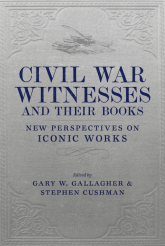
Civil War Witnesses and Their Books (LSU Press, 2021) 314 pages; ISBN: 9780807175804
[To purchase, click HERE.]
Civil War Witnesses and Their Books: New Perspectives on Iconic Works serves as a wide-ranging analysis of texts written by individuals who experienced the American Civil War. Edited by Gary W. Gallagher and Stephen Cushman, this volume, like its companion, Civil War Writing: New Perspectives on Iconic Texts (2019), features the voices of authors who felt compelled to convey their stories for a variety of reasons. Some produced works intended primarily for their peers, while others were concerned with how future generations would judge their wartime actions. One diarist penned her entries with no thought that they would later become available to the public. The essayists explore the work of five men and three women, including prominent Union and Confederate generals, the wives of a headline-seeking US cavalry commander and a Democratic judge from New York City, a member of Robert E. Lee’s staff, a Union artillerist, a matron from Richmond’s sprawling Chimborazo Hospital, and a leading abolitionist US senator.
Civil War Writing: New Perspectives on Iconic Texts
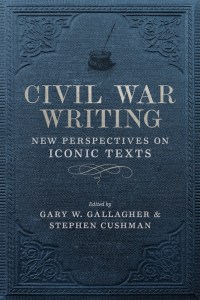
Civil War Writing (LSU Press: 2019) 312 Pages; ISBN: 9780807170243
[To purchase, click HERE.]
Civil War Writing is a collection of new essays that focus on the most significant writing about the American Civil War by participants who lived through it, whether as civilians or combatants, southerners or northerners, women or men, blacks or whites. Collectively, as contributors show, these writings have sustained their influence over generations and include histories, memoirs, journals, novels, and one literary falsehood posing as an autobiographical narrative. Several of the works, such as William Tecumseh Sherman’s memoirs or Mary Chesnut’s diary, are familiar to scholars, but other accounts, including Charlotte Forten’s diary and Loreta Velasquez’s memoir, offer new material to even the most omnivorous Civil War reader. In all cases, a deeper look at these writings reveals why they continue to resonate with audiences more than 150 years after the end of the conflict.
The Princeton Encyclopedia of Poetry and Poetics
Fourth Edition

The Princeton Encyclopedia of Poetry & Poetics (Princeton University Press, 2012) 1680 pages; ISBN: 978-0691154916
[To purchase, click HERE.]
Through three editions over more than four decades, The Princeton Encyclopedia of Poetry and Poetics has built an unrivaled reputation as the most comprehensive and authoritative reference for students, scholars, and poets on all aspects of its subject: history, movements, genres, prosody, rhetorical devices, critical terms, and more. Now this landmark work has been thoroughly revised and updated for the twenty-first century. Compiled by an entirely new team of editors, the fourth edition–the first new edition in almost twenty years–reflects recent changes in literary and cultural studies, providing up-to-date coverage and giving greater attention to the international aspects of poetry, all while preserving the best of the previous volumes
At well over a million words and more than 1,000 entries, the Encyclopedia has unparalleled breadth and depth. Entries range in length from brief paragraphs to major essays of 15,000 words, offering a more thorough treatment–including expert synthesis and indispensable bibliographies–than conventional handbooks or dictionaries.
This is a book that no reader or writer of poetry will want to be without.
- Thoroughly revised and updated by a new editorial team for twenty-first-century students, scholars, and poets
- More than 250 new entries cover recent terms, movements, and related topics
- Broader international coverage includes articles on the poetries of more than 110 nations, regions, and languages
- Expanded coverage of poetries of the non-Western and developing worlds
- Updated bibliographies and cross-references
- New, easier-to-use page design
- Fully indexed for the first time
“Ever since the first edition of this work, in 1965, The Princeton Encyclopedia of Poetry and Poetics has been a comprehensive and authoritative reference work valued by students, teachers, and poets. . . . This edition will be welcomed by all readers of poetry. It provides so many new essays and updates, and, finally, has an index, which is useful as the Encyclopedia does not include entries on individual poets, but rather discusses them in the context of the larger topics to which they are related. Also beneficial is the new page layout that is easier to read and more conducive to browsing. Highly recommended.”—Library Journal (Starred Review)
“[T]he Princeton Encyclopedia has earned its reputation as the standard reference work for the array of topics comprehended by the study of poetry. . . . [I]ts coverage of an impressive range of poetic traditions hitherto relatively unheralded in mainstream Western criticism is one of its most prominent achievements. . . . [T]his edition of the Encyclopedia has turned concertedly to expert specialists in non-Western poetries like never quite before, which allows for subtle, well-informed and finely grained entries across (almost) the full range of world poetries. . . . [T]his fourth edition of The Princeton Encyclopedia superlatively fulfils its nearly fifty-year-old commitment to, as the preface to the first edition had it, ‘accuracy, utility, interest, and . . . thoroughness.'”—Ross Wilson, Times Literary Supplement

